Stainless steel casters that survive the washdown.
Stainless steel casters exist for one reason: the environment eats everything else. This line is built on 304 stainless forks, plates and hardware for food processing, beverage, pharmaceutical-adjacent and marine-adjacent equipment — with the grade stated per component, never implied.
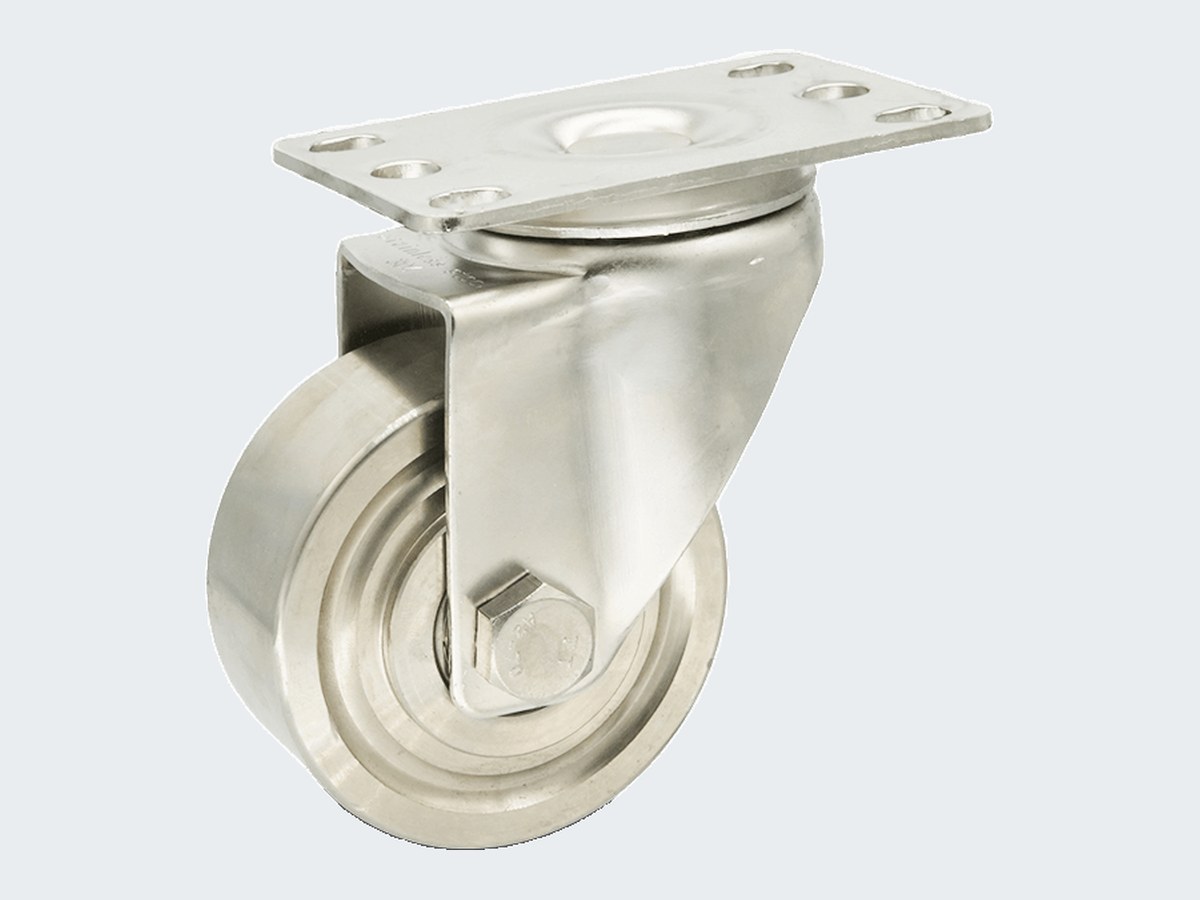
A zinc-plated caster in a washdown plant is a countdown timer. Caustic foam, chlorinated cleaners, steam and standing water strip plating in months, and the rust that follows is both a hygiene failure and a mechanical one. Stainless steel casters remove the coating from the equation entirely: the fork, top plate, axle and hardware are stainless through their cross-section, so a scratched fork is a cosmetic event instead of the start of corrosion.
304 first — and the 316 question, answered straight
Our lead stainless line is built in 304 stainless steel, the grade that covers the large majority of food and beverage equipment duty. You will see 316 stainless casters sold at a substantial premium for marine and high-chloride environments. Two things buyers should know. First, 304 and 316 are not interchangeable in price or performance, and any comparison between a 304 caster and a 316 caster that does not name the grades is not a comparison. Second, if your environment genuinely needs 316 — sustained saltwater exposure, specific chemical regimes — say so in the RFQ and we will quote it as its own specification rather than quietly shipping 304 against a 316 expectation. Our stainless casters for food and washdown guide works through the grade decision in detail.
The lead configurations
| Configuration | Mounting | Typical duty |
|---|---|---|
| 5 in stainless swivel | Top plate | Food equipment, trolleys, processing lines |
| 5 in stainless swivel with brake | Top plate | Equipment that must park on sloped washdown floors |
| Rigid companions | Top plate | Paired with swivels for straight tracking |
Wheels on this line are polyurethane tread — non-marking, washdown-tolerant and quiet — with bearing and seal arrangements specified for wet duty. Bearing specification matters more here than anywhere: an open bearing in a washdown caster is a water trap, so the quotation states the bearing and sealing arrangement explicitly.
Hygiene details that are actually specifications
- Grade per component. Fork, plate, axle, nuts and brake hardware each stated — a stainless fork on carbon-steel hardware is a plated caster wearing a costume.
- Surface finish. Polished or brushed finish stated; rough finishes hold soil and slow sanitation.
- Drainage and crevices. Institutional and food buyers increasingly ask about hollow sections and water traps; tell us your sanitation standard and we will specify against it.
- Cleaning chemistry. Chlorinated alkaline cleaners are routine in food plants; if your regime includes stronger chlorides, that is the 316 conversation — have it before ordering, not after the first rust spot.
The specification we lock before quoting
A quotation is only comparable when the specification underneath it is fixed. For this line — as for every CASTOVELLA line — the written quotation locks these six variables, and the production sample is checked against them before bulk production is approved:
- Wheel diameter and width — width is both a performance variable and the US tariff classification variable; it is measured on the sample, not copied from a catalogue.
- Tread material and hardness — stated as a Shore hardness range, so the bulk shipment can be checked against the approved sample.
- Bearing type — plain, roller or precision ball bearing, named on the quotation; bearing swaps are the most common silent downgrade in this industry.
- Fork and top plate thickness — measured in millimetres and stated, because fork flex is where cheap heavy duty casters fail first.
- Load capacity and test method — capacity per caster with the test convention named (EN 12532 / ANSI ICWM), never a bare number.
- Finish and hardware — zinc plating, stainless grade or coating stated per component, not per marketing photo.
Buyer questions
Is 304 stainless enough for a food processing plant?
For most food and beverage washdown duty, yes — 304 is the industry's default equipment grade. Sustained high-chloride exposure (brine, seawater, some chemical regimes) is where 316 earns its premium. Tell us your cleaning chemicals and environment and the quotation will state the grade it is built on.
Do stainless casters cost more than plated ones?
Yes — stainless material costs more than plated carbon steel, and this site publishes no prices in any case. The comparison that matters is service life in your environment: a plated caster replaced twice in a washdown plant costs more than the stainless caster that outlasts both.
Can stainless casters be used outdoors?
Yes. Stainless is the standard answer for outdoor equipment that cannot be sheltered, including coastal-adjacent duty in 304 and full marine exposure in 316 by specification.
What wheel material pairs with stainless forks?
Our lead stainless configuration pairs a synthetic rubber tread — washdown-tolerant, non-marking and quiet. The wheel core and bearing specification are stated on the quotation alongside the fork grade.
Are brakes available on the stainless line?
Yes — the lead 5 inch swivel is also offered with a total-lock style brake. Brake hardware grade is stated with the rest of the specification.
Price this line against a locked specification.
Send diameter, width, load per caster, quantity and destination port. The reply states the full specification the quotation is built on.