Rubber caster wheels for rough floors and hard knocks.
Rubber caster wheels trade some load capacity for the two things polyurethane cannot give: shock absorption and grip on imperfect surfaces. This line covers elastic solid rubber and TPR (thermoplastic rubber) wheels for carts, containers and institutional equipment.
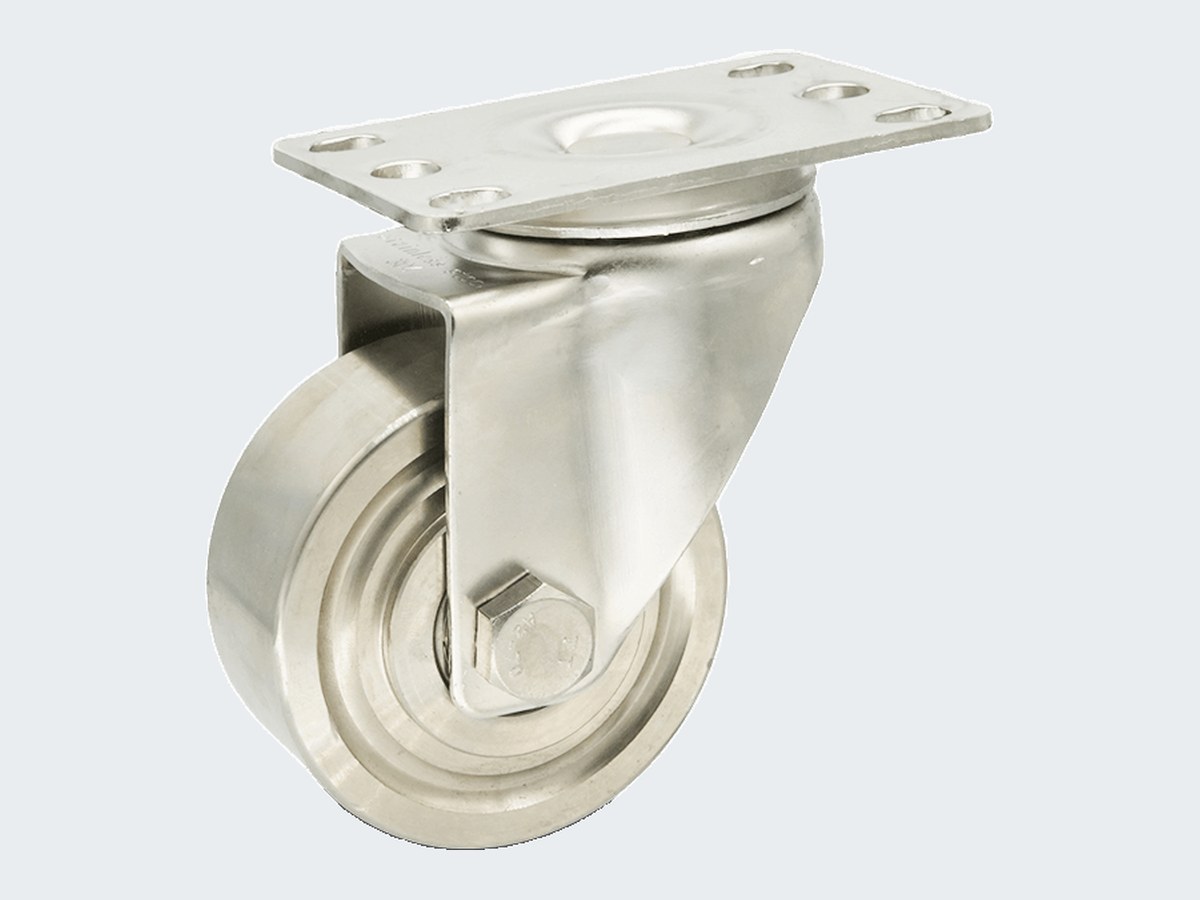
Every material line exists because another material fails somewhere. Polyurethane fails the shock test: roll a loaded cart over a dock plate lip or a cracked yard joint on hard PU and the impact goes straight into the load and the fork. Rubber caster wheels absorb that impact. They also grip wet and dusty surfaces where a hard tread skates, and they are the quietest option per dollar in institutional settings — hospitals, hotels, schools — where noise is a specification, not a preference.
Elastic rubber vs TPR
| Property | Elastic solid rubber | TPR (thermoplastic rubber) |
|---|---|---|
| Shock absorption | Best in this line | Good |
| Load capacity | Moderate | Light to moderate |
| Floor behaviour | Non-marking grades available | Non-marking, very quiet |
| Typical duty | Waste containers, yard carts, rough concrete | Medical and institutional carts, light equipment |
| Weakness | Cuts and chunking around metal swarf | Flattens under sustained heavy standing load |
The TPR end of this line includes the 4 inch medical and institutional caster — a secondary line for us, quoted from live factory pricing rather than a standing programme, because institutional buyers specify tightly (total-lock brakes, sealed bearings, specific stem fittings) and deserve a quotation built on their exact fitting, not a catalogue average. See the 4 inch TPR medical caster page for how that line works.
Where rubber is the wrong answer
Honesty about limits is part of the specification discipline. Rubber is wrong for sustained heavy loads on smooth floors (rolling resistance punishes the operator), wrong around sharp metal swarf (the tread cuts), and wrong for high temperature. If your RFQ describes those conditions we will steer you to the polyurethane line or the high temperature line and tell you why — a returned container costs more than a redirected inquiry.
Sizes and mountings
Rubber caster wheels run across the institutional and medium duty sizes, on plate, stem and bolt-hole mountings. Waste-container and cart applications usually pair two swivel (often braked) with two rigid casters; the swivel vs rigid guide covers layout. State your floor surface and the worst joint or threshold the wheel must cross in the RFQ — for this line, the floor decides the compound.
The specification we lock before quoting
A quotation is only comparable when the specification underneath it is fixed. For this line — as for every CASTOVELLA line — the written quotation locks these six variables, and the production sample is checked against them before bulk production is approved:
- Wheel diameter and width — width is both a performance variable and the US tariff classification variable; it is measured on the sample, not copied from a catalogue.
- Tread material and hardness — stated as a Shore hardness range, so the bulk shipment can be checked against the approved sample.
- Bearing type — plain, roller or precision ball bearing, named on the quotation; bearing swaps are the most common silent downgrade in this industry.
- Fork and top plate thickness — measured in millimetres and stated, because fork flex is where cheap heavy duty casters fail first.
- Load capacity and test method — capacity per caster with the test convention named (EN 12532 / ANSI ICWM), never a bare number.
- Finish and hardware — zinc plating, stainless grade or coating stated per component, not per marketing photo.
Buyer questions
Are rubber caster wheels non-marking?
Non-marking compounds are available in both elastic rubber and TPR and are the default we quote for institutional duty. Standard black industrial rubber can mark soft floors — if the floor matters, say so in the RFQ so the compound is specified correctly.
Rubber or polyurethane for a warehouse cart?
Smooth sealed concrete and heavy loads: polyurethane. Cracked floors, dock plates, outdoor yards and shock-sensitive loads: rubber. Many distributors stock both and let the application decide.
What stem fittings can you supply for institutional casters?
Threaded stems, grip-ring stems and expanding fittings are all standard furniture/institutional interfaces; the exact fitting and thread are part of the locked specification. Send the socket or stem drawing with your RFQ.
Do TPR wheels suit medical environments?
TPR is the common institutional tread — quiet, non-marking, and compatible with routine cleaning. Chemical resistance depends on the disinfectants used; tell us the cleaning regime and we will confirm compound suitability before quoting.
Price this line against a locked specification.
Send diameter, width, load per caster, quantity and destination port. The reply states the full specification the quotation is built on.